Clinical Cases to Challenge, Teach, and Refine Your Ophthalmic Practice
Welcome to a curated collection of real-world ophthalmic cases drawn from clinical practice. Each image is paired with a focused clinical insight and a key takeaway designed to sharpen your diagnostic thinking and refine your treatment approach. From corneal ulcers and hypopyon to uveal cysts, hyphema, and beyond, these cases reflect the complexity and nuance that defines veterinary ophthalmology in practice.
Whether you're a seasoned clinician or still building your ophthalmic confidence, this page is designed to challenge assumptions, highlight the findings that matter most, and prompt the kind of critical thinking that changes outcomes. Each case invites you to look closer, consider the differential, and ask what you might have missed.
Scroll through, engage with the questions, and test your clinical instincts — because in ophthalmology, what you see is only the beginning.
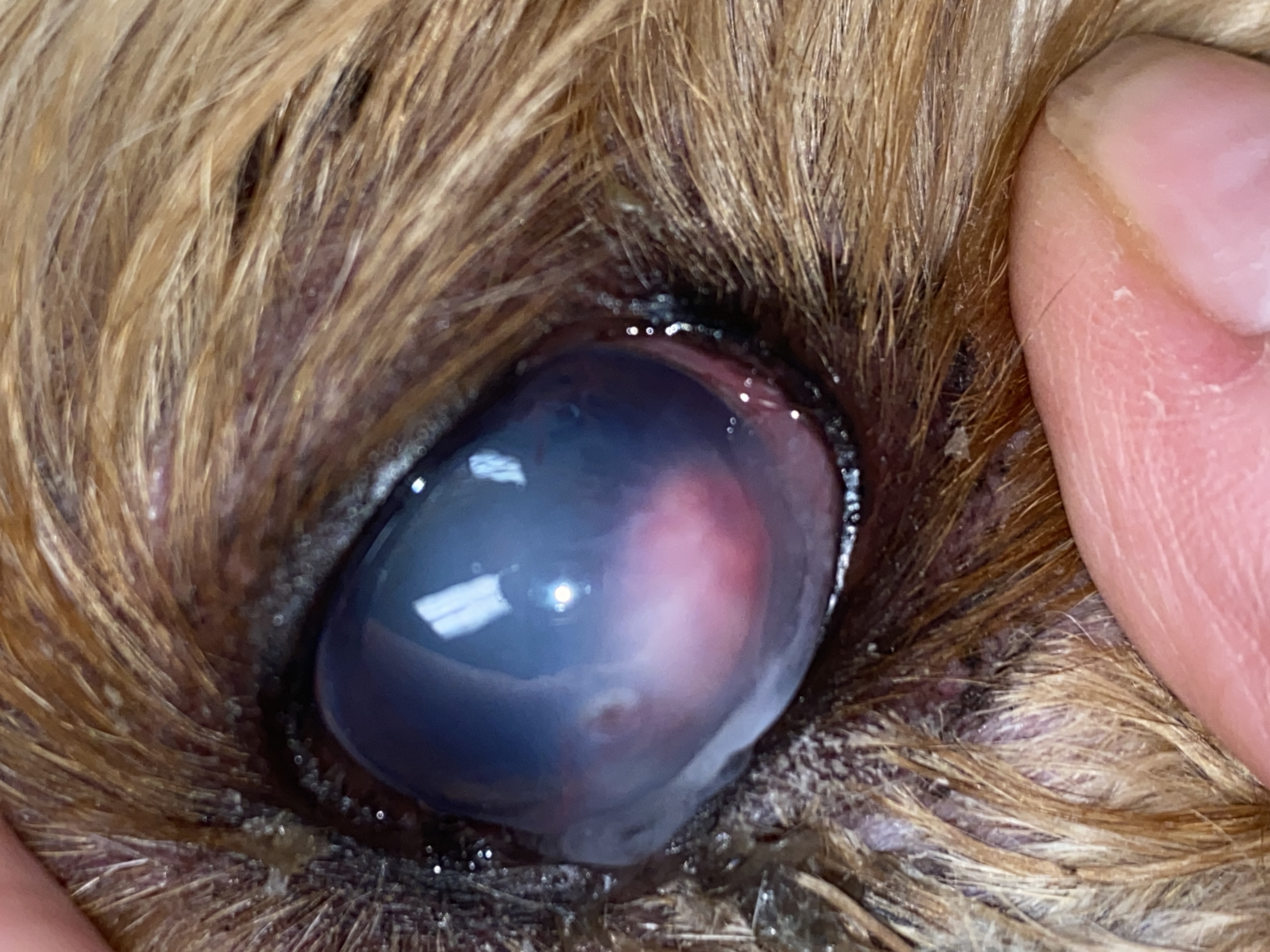
Hypopyon with Corneal Ulcer and Abscess: When It's Not Just Uveitis
Hypopyon doesn’t always mean “just uveitis”—sometimes the cornea is the real problem.
Clinical Insight:
Corneal edema with vascularization and a hypopyon can be seen in both severe uveitis and infectious corneal disease. The key distinction is whether the cornea itself is compromised. Subtle or delayed fluorescein uptake, focal opacity, and marked pain should raise suspicion for a deep ulcer or early abscess. Look at the circular yellow infiltrate nasally at the terminus of the vessels and hypopyon
Takeaway:
If there’s any doubt, treat as an ulcer first. Missing an infection and reaching for steroids or even a topical NSAID can rapidly worsen the outcome and potentially worsen the visual prognosis.
Clinical Insight:
Corneal edema with vascularization and a hypopyon can be seen in both severe uveitis and infectious corneal disease. The key distinction is whether the cornea itself is compromised. Subtle or delayed fluorescein uptake, focal opacity, and marked pain should raise suspicion for a deep ulcer or early abscess. Look at the circular yellow infiltrate nasally at the terminus of the vessels and hypopyon
Takeaway:
If there’s any doubt, treat as an ulcer first. Missing an infection and reaching for steroids or even a topical NSAID can rapidly worsen the outcome and potentially worsen the visual prognosis.